
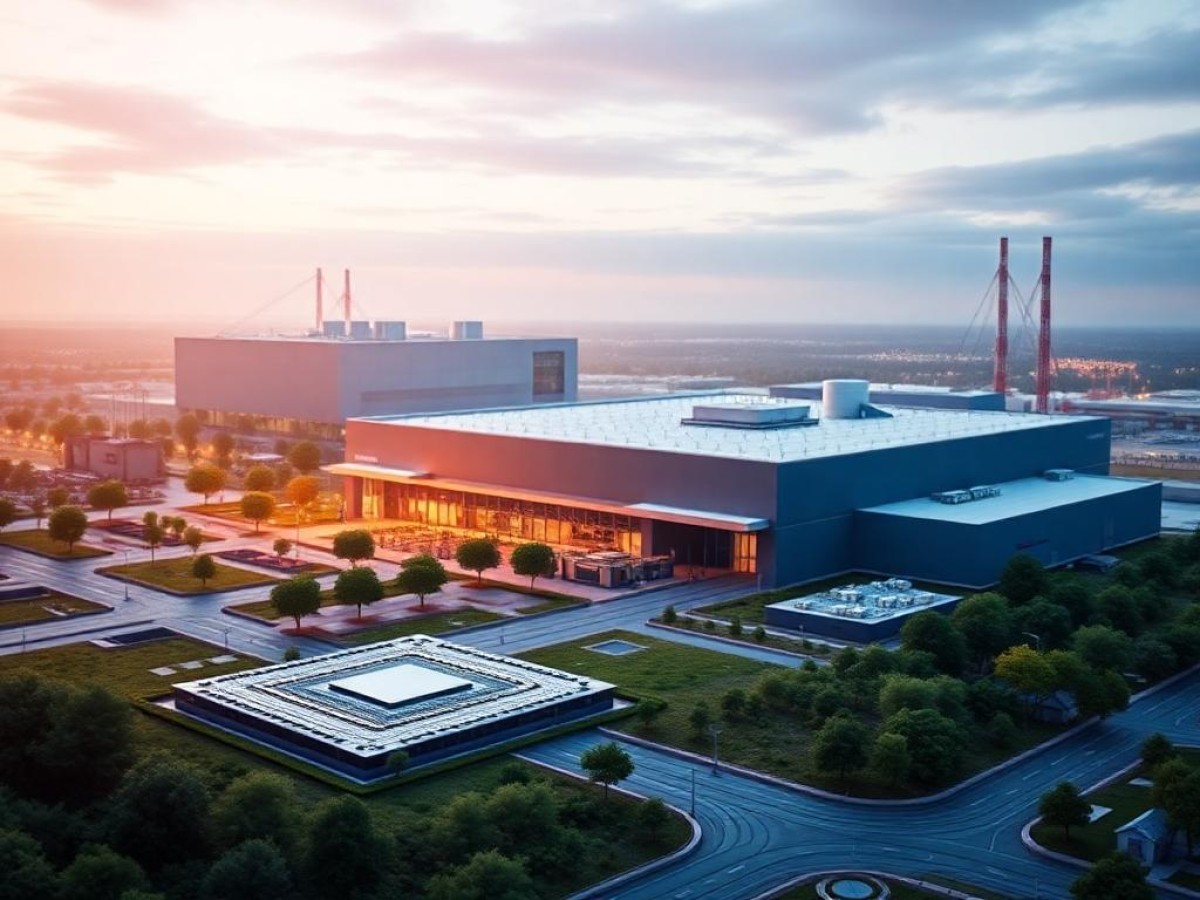
Just before the holiday season, the U.S. government secured funding agreements with three major companies—Samsung, Ankor, and Texas Instruments. These agreements will enable the construction of a state-of-the-art 2nm chip fabrication plant, a cutting-edge packaging facility, and three substantial fabs that will produce millions of analog and embedded chips daily.
Samsung’s 2nm Innovation Arrives in America
Under the CHIPS and Science Act, Samsung will receive up to $4.745 billion in U.S. government funding. Although this is a significant investment, it should be noted that it is $1.65 billion less than initially announced in April—a reduction likely reflecting a $3 billion cut in Samsung’s investment plan amid broader budget reevaluations in its semiconductor sector.
This financial support will bolster Samsung’s ambitious $37 billion effort to construct a two-phase top-tier fab in Taylor, Texas, alongside an R&D facility. This project also includes initiating production using fully depleted silicon-on-insulator (FD-SOI) process technologies for the aerospace, automotive, and defense industries in the U.S., with completion and full operational status expected by 2030.
The planned fabs will utilize Samsung’s advanced 2nm-class process technologies, although specific nodes have not been disclosed. The company has rebranded its SF2 node to SF3P, and it is believed that its successors—SF2P, SF2X, and SF2Z—are genuine 2nm-class nodes designed from the outset.
Beyond these two fabs, Samsung is setting up a specialized R&D facility to focus on developing manufacturing processes that surpass current capabilities. This facility will also allow its staff to train on next-gen tools and collaborate closely with fab equipment vendors. It will also support partnerships to innovate new materials, including ultra-pure gases and resists.
Additionally, Samsung plans to expand its Austin, Texas fab to manufacture chips using its FD-SOI technology, previously only utilized in South Korea, for the U.S. aerospace, automotive, and defense industries.
The construction phase of these projects is expected to create over 17,000 jobs, with an additional 4,500 permanent manufacturing positions within five years.
Amkor Secures $407 Million for Advanced Packaging Facility
Amkor, a prominent outsourced semiconductor assembly and test (OSAT) company, will receive $407 million from the Biden-Harris administration to construct a $1.7 billion advanced packaging facility in Peoria, Arizona—a slight decrease from the initially anticipated $2 billion.
The new plant will offer over 500,000 square feet of cleanroom space on a 55-acre site, catering to a range of packaging technologies including traditional, 2.5D, and 3D. Set to become operational by the end of 2027, the facility will be strategically located near TSMC’s Fab 21 in Arizona, primarily serving TSMC’s clients, with Apple as a key customer. This project is expected to generate 2,000 construction jobs and another 2,000 in manufacturing.
Texas Instruments: Expanding with Multiple Fabs
Texas Instruments has been promised up to $1.6 billion in CHIPS Act funding and anticipates $8 billion in tax credits for expanding its semiconductor production in Texas and Utah.
The funding will be used to outfit the cleanroom for Sherman’s first phase, construct the second phase shell, and enhance the Lehi fab with advanced tools likely tailored for logic. These facilities will focus on producing analog and embedded chips using specialty production nodes ranging from 28nm to 130nm, key for automotive and medical devices. This expansion is expected to create over 2,000 direct jobs at Texas Instruments, with thousands more in construction and related fields.
Similar Posts
- Samsung Slashes Foundry Investment to $3.5B, Rivals Ramp Up Spending, Report Reveals
- Samsung Shakes Up Semiconductor Leadership Amid Memory and NAND Struggles
- Taiwan Set to Discuss 2nm Tech Transfer to U.S. After Trump’s Remarks
- Intel vs. TSMC Process Nodes Battle: Speed or Density – Which Wins?
- India’s First 28nm Semiconductor Chip Launching This Year!

Avery Carter explores the latest in tech and innovation, delivering stories that make cutting-edge advancements easy to understand. Passionate about the digital age, Avery connects global trends to everyday life.


